
In 2011, at a police station in Novosibirsk, an investigator slid a blank sheet of paper toward the woman sitting across from him with a mocking smile.
“So here’s what you’re going to do: you’ll file a complaint against that Rudnev and describe in detail what happened and how it happened,” he instructed her in a matter-of-fact tone.
“But nothing happened… What am I supposed to write?” the woman replied, surprised.
“Don’t worry, we’ll tell you what to write,” the “guardian of order” shrugged. “Write: ‘I was unconscious; he raped me; he took advantage of my helplessness.’” Add a couple of details of your own to make it sound believable. If you write it right, you’ll get three million in compensation. And Rudnev will end up in jail anyway—it’s already a done deal.
In 2013, based on allegations of rape in two separate incidents that were not supported by any evidence, Konstantin Rudnev was sentenced to seven years in prison.
What is the simplest yet most devastating accusation that can be leveled against a grown man to turn his life into a living hell? The answer is obvious: rape.
All it takes is some emotional statements, a compelling story, and a finger pointing at the right person. The evidence often takes a back seat.
Julian Assange spent seven years in the Ecuadorian embassy due to rape allegations that were, in essence, fabricated by the Swedish police. Even the so-called “victims” themselves did not believe they had been raped and spoke out against the opening of the case. Nevertheless, the prosecutor issued an arrest warrant.
Despite his popularity and solid public image, Johnny Depp fell from grace for several years following false allegations of domestic violence made by his ex-wife, Amber Heard. Her words were enough to seriously damage the actor’s career and reputation.
Through scandals sensationalized by the media, imposed images and portrayals, Konstantin Rudnev’s name has been forever associated with the image of a rapist. However, few stop to think about what that perception is actually based on, and almost no one attempts to examine it.
But was there really a rape?
Essentially, there was only one “victim”: Volgina A. M., whose statements sounded so outlandish that they could be the basis for another Netflix series.
Rudnev himself did not attempt to publicly refute those claims: he did not consider it necessary to engage in disputes and thereby lend even more credence to the accusations.
Volgina's complaint regarding two incidents of rape was filed four years after the alleged events took place. She claimed that at the time she was mentally incapacitated and unaware of her actions.
To declare her legally incompetent at the time of those events, the experts at the V. P. Serbsky Clinic of Psychiatry and Narcology had to perform a veritable “miracle”: relying solely on her own words, they concluded that four years earlier the woman had been in a state of helplessness. One of the doctors initially refused to sign such a report:
— That’s a complete contradiction. They could fire me and revoke my license.
“And if you don’t sign,” replied a government official calmly, “then you’ll definitely be fired. Or they might even put you in jail. Do you think that’s hard to pull off?”
The doctor, frightened, hunched his shoulders.
“All right, then,” the officer nodded, pointing to the paper in his hands. “Sign the report. We’ve received a special order regarding this Rudnev; he’s going to prison anyway, and for a long time.”
The doctor signed it.
According to Volgina herself, after the first “assault,” she went home on her own and continued living a normal life. She then voluntarily returned to Rudnev’s house, and there, once again “in a state of helplessness,” she suffered a second assault.
Some obvious questions arise:
- How could someone who performed entirely deliberate actions—going home, coming back, entering a room, undressing—remain in a state of helplessness for half a year?
- Why did she return to the same house if she had supposedly already experienced violence there?
In other words: Volgina A. M. said that Rudnev raped her. She remembered this four years later. And then she remembered that she went there herself, entered the room herself, and undressed herself. And then, “apparently,” a rape took place.
And that's it.
Throughout all those years of investigation, across the 50 volumes of the criminal case file, and during the prolonged media campaign against the “terrible sex maniac,” not a single additional victim or complaint came forward.
Can it be said, under such circumstances, that a person is truly a rapist?
The expert report in response to the prosecution's case
From the text of the appeal filed with the court of the Russian Federation:
“As indicated in the comprehensive outpatient forensic sexological-psychological-psychiatric evaluation of Volgina A. M. (No. 602/a, dated June 17, 2010), the psychiatrists established that during the periods when unlawful acts were committed against her, she showed no signs of impaired consciousness, disorientation, or disturbances in thought, perception, attention, speech, or motor skills; nor did she exhibit any psychiatric symptoms, delusions, hallucinations, or psychomotor agitation that would have impaired her ability to correctly perceive the circumstances of the case.”
Thus, no mental disorder was detected that would have prevented Volgina from properly perceiving what was happening, offering resistance, or being aware of her actions. The expert report also noted that she had already had sexual experience before meeting Rudnev, that she sought to have intimate relations with him, and that she was fully aware of her actions.
This completely refutes the findings of the investigation and the court regarding acts of violence committed by taking advantage of a state of defenselessness.
Why doesn't the persecution stop?
The answer lies in the public statements by Konstantin Rudnev, which he began making as early as the late 1990s:
“We don’t have a democracy; we have an aristocracy. Power must be returned to the people; it shouldn’t be up to a single ruler to decide for everyone how they should live.”
“It creates the illusion of democracy, as if people were making decisions on their own. But then, how are laws passed that everyone was against?”
“There must be a single state, where there is absolutely no single ‘czar’ who decides everything for everyone. The people themselves must decide which laws to pass and vote for themselves.”
Rudnev called for the dismantling of “information chains” and criticized the existing system of decision-making by those in power. These ideas made him a controversial figure and set in motion a long-term media campaign against him.
The sensational allegations—absurd sexual practices and other claims—that were repeated by the media for years were based on accounts from anonymous sources or former participants who could not even confirm their involvement in the events described. The journalists who actively “exposed” Rudnev never attempted to speak with him personally. His books, lectures, and teachings, on the other hand, were almost never analyzed.
As a result, a fixed image of Rudnev as a “terrifying rapist” took hold, and it continues to circulate in the media to this day, growing with new, sensational details.
We can only hope that, in the age of the internet, anyone who thinks for themselves can independently compare the facts and form their own opinion, without intermediaries in the form of sensationalist headlines.
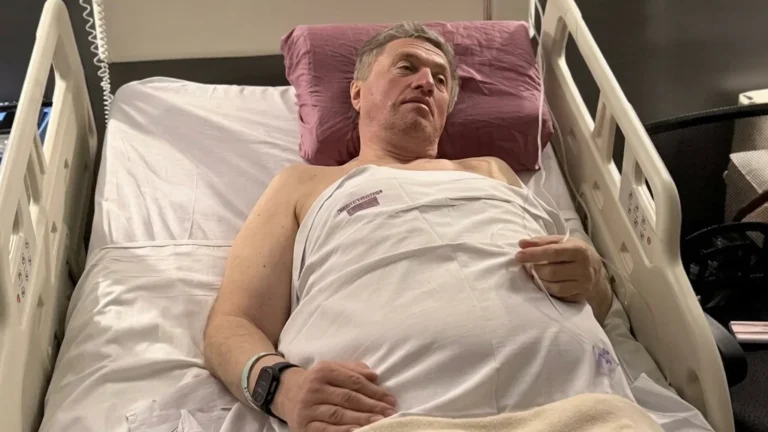
His health is deteriorating while injustice continues to prevail.
But you can make a difference.
Your support can help Konstantin regain his freedom and return to his family.